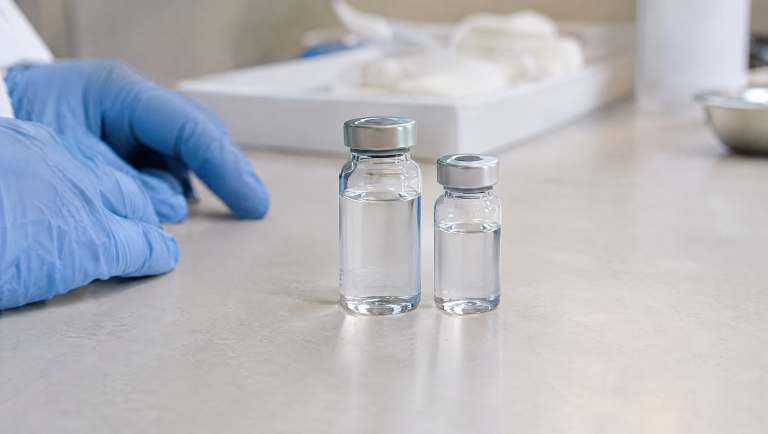

The research on GLP-1 microdosing is thin. A 2026 commentary in Expert Opinion on Pharmacotherapy called high-quality evidence “essentially absent.” The nearest controlled data come from older dose-finding trials. In one, semaglutide 0.05 mg a day produced a 6.0% weight loss at 52 weeks, against 2.3% on placebo, and that was not a microdosing study. Microdosing is not an FDA-approved dosing schedule.
That 2018 trial, published in The Lancet, gets quoted a lot, so its details count. Patients injected the drug every day, and daily dosing changes the math. Seven doses of 0.05 mg add up to 0.35 mg a week, which is more than the 0.25 mg weekly dose Wegovy now starts with. The trial was testing what dose to carry forward, and higher doses in it did better, reaching 13.8% at 0.4 mg a day. Reading it as proof that tiny doses work asks more of it than it can give.
Tirzepatide has a similar early trial. A 2018 phase 2 study of the drug, then called LY3298176, tested doses from 1 mg to 15 mg in adults with type 2 diabetes for 26 weeks. Weight change ranged from a loss of 0.9 kg to a loss of 11.3 kg across those doses. Stomach and bowel side effects rose with dose as well, from 23.1% at 1 mg to 66.0% at 15 mg, against 9.8% on placebo. That is useful information about dose and tolerance. It is not evidence about weight loss in people without diabetes on a long-term low dose.
What have recent GLP-1 microdosing research papers found?
Mostly, they have found gaps. The 2026 commentary, written by University of South Carolina pharmacy researchers, reports that early accounts suggest less nausea, better adherence and modest weight loss. It then says the quality of that evidence remains limited and raises concerns about compounded products and dose measurement.
A 2026 narrative review in Cureus carries the title “Multisystem Benefits of GLP-1 Microdosing.” According to a News-Medical summary, the review was not systematic. It leaned on indirect support, including an observational study of low-dose tirzepatide, a pooled analysis of semaglutide at 0.5 mg and 1 mg, and a single case report. The same summary says the authors warned that benefits seen at standard doses cannot be assumed at fractional ones.
Medical groups have been blunter. The American Association of Clinical Endocrinology has said peer-reviewed evidence of safety and effectiveness is absent, and its president does not support routine microdosing in clinical care. Yale Medicine notes that doses below the lowest labeled ones have not been studied. Cedars-Sinai says the same about low-dose, intermittent use and meaningful, lasting weight loss.
What is the closest strong evidence on lower doses?
The closest strong evidence comes from a trial that was not about microdosing. SURMOUNT-MAINTAIN, published in The Lancet in 2026 and funded by Eli Lilly, took people who had lost weight on 10 mg or 15 mg of tirzepatide. It split them three ways for a further 52 weeks. By week 112, the model-based weight loss from baseline was 21.9% for those who stayed on their dose. It was 16.6% for those who dropped to 5 mg and 9.9% for those switched to placebo.
The authors called the 5 mg step a possible alternative to stopping. But 5 mg is an approved Zepbound maintenance dose. The trial did not test doses below the label or compounded products, so it cannot be stretched to cover them.
What is missing is plain. We could not find a large randomized trial that defines a microdose, holds people to it for a year or more, and reports weight, side effects and muscle. AARP adds another open question: whether heart and kidney protection seen at standard doses would hold at lower ones.
Some medications prescribed through Living+ are compounded, and compounded drugs are not FDA-approved. A licensed provider decides whether a lower dose is appropriate for a given person and may decide against it. That decision is being made today with less data than anyone would like, and this article will need rewriting the day a real trial reads out.
Quick answers
Is there a clinical trial on GLP-1 microdosing?
We did not find a large randomized trial that defines a microdose and tests it over the long term. The closest data come from early dose-finding trials and from a 2026 trial of stepping down to an approved 5 mg tirzepatide dose. Neither one tested microdosing as it is marketed today.
Does microdosing lower inflammation?
Good evidence for that claim is lacking. A Yale clinician quoted by AARP said social media claims about inflammation lack evidence. Treat any strong promise on this subject with suspicion.
Why do some clinicians prescribe a microdose if evidence is limited?
Commentary in the medical literature cites tolerance, cost and access as the main reasons. That explains why it happens but does not prove that it works. Microdosing is not an FDA-approved dosing schedule.
Do full-dose trial results apply to a microdose?
No. Trial results belong to the drugs and doses that were studied. A 2026 review summary states that benefits at standard doses cannot be assumed at fractional doses, and compounded products were not tested in those trials.
Sources
- Beck and Clements, Considerations and challenges in microdosing of GLP-1-based receptor agonists, Expert Opin Pharmacother 2026
- O'Neil et al., Semaglutide compared with liraglutide and placebo, The Lancet 2018
- Frias et al., Phase 2 trial of LY3298176 (tirzepatide) in type 2 diabetes, The Lancet 2018
- Panlilio et al., Multisystem benefits of GLP-1 microdosing, a narrative review, Cureus 2026
- News-Medical: GLP-1 drugs have benefits beyond weight loss. Could microdoses preserve them?
- AACE: GLP-1RA microdosing trend continues despite anecdotal evidence
- Yale Medicine: Microdosing GLP-1 and Accutane, what does it mean and does it work
- Cedars-Sinai: Can microdosing GLP-1s promote health and weight loss?
- Horn et al., SURMOUNT-MAINTAIN, The Lancet 2026
- AARP: Microdosing GLP-1 drugs for weight loss
See what a Living+ plan costs and whether it fits.
Wegovy is a registered trademark of Novo Nordisk A/S. Zepbound is a registered trademark of Eli Lilly and Company. Living+ is not affiliated with or endorsed by these companies.