
Your fitness tracker, your calculator, and your food label are all guessing
A number you’ve been living by may be wrong. Not a little wrong. Wrong in ways that stack.
People say this on GLP-1 forums all the time, and they say it to their providers too. I’m staying under my calories. I’m wearing a tracker. The app says I’m doing everything right, and the scale won’t move. We believe you. The problem is that the numbers feeding your plan are estimates. Population averages, proprietary algorithms, federal tolerances that allow a meaningful gap between what the label says and what’s in the food. None of that is a secret. It just doesn’t get said plainly.
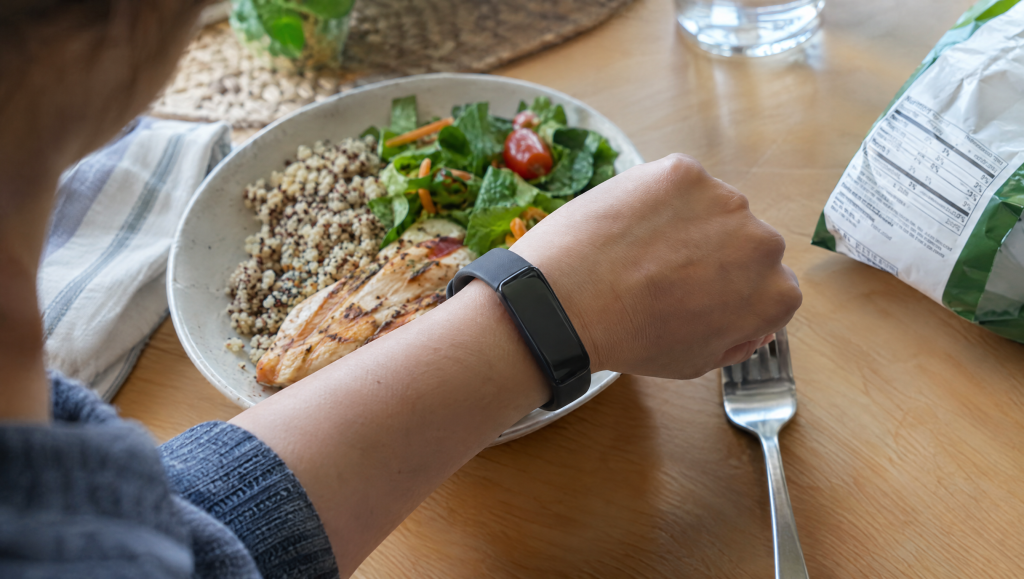
Fitness trackers do a decent job measuring heart rate. They do a poor job estimating how many calories you burned. A Stanford study tested seven major wrist-worn devices using clinical-grade indirect calorimetry as the reference. No device came within 20 percent of actual energy expenditure. The best performer, the Fitbit Surge, had a median error of 27 percent. A 2026 FIU study of four popular smartwatches found typical errors of 15 to 25 percent, with the worst-performing devices averaging much higher. Both studies noted that error tended to be larger in people with higher body fat. That group is usually the one trying hardest to track calories.
This matters for a specific reason. Say your tracker reports 400 calories burned on a walk. The real number was 290. You eat those 400 back because the app said it was fine. That’s a quiet surplus you can’t see.
The standard advice in exercise physiology has been “don’t eat back your exercise calories” precisely because the burn estimates are unreliable. Your tracker cheers you on. That’s fine. Just don’t let it set your food budget.
The FDA permits a food label to be off by up to 20 percent on calories before it’s considered non-compliant (21 CFR 101.9(g)). That’s the regulatory tolerance, not a rare edge case. A food labeled at 300 calories per serving can legally contain 360. A labeled 500-calorie meal could be 600. When you’re tracking every bite, that margin matters.
TDEE calculators have their own error layer. The most widely used formula, Mifflin-St Jeor, predicts resting metabolic rate within 10 percent for roughly 80 percent of normal-weight adults. For people with hormonal differences, more body fat, or a history of calorie restriction, that range widens. The activity multiplier layered on top (sedentary, moderately active, very active) is a rough guess. What you get out is a starting point. Nothing more.
Add three imprecise numbers together and the uncertainty multiplies. A tracker off by 20 percent, a label off by 15 percent, a calculator off by 10 percent, all on the same day, all pointing the same direction. That’s a real scenario, and not an unusual one.
What the data actually is
The only number in your plan that is measured rather than estimated is your actual result. How your weight is trending over four to six weeks. How your measurements are moving. Whether your clothes fit differently. That’s real data. The app’s estimate of your burn is a model. Your body’s response is the observation.
Your body’s response is the observation.
When a provider adjusts your plan, they’re working from your results, not from what a formula predicted. That’s the correct way to use this. The numbers get you started. What happens on your body tells you whether the numbers are close.
Some people on GLP-1s find the medication has already reduced appetite enough that precise calorie counting feels manageable for the first time. Others find the data still lies to them and the scale reflects it. Both experiences are real. A provider who checks in regularly can look at what is actually happening and make changes that a calculator cannot.
Don’t eat back exercise calories your tracker says you burned. Assume food labels are close but not exact, and that small errors compound across a day. Treat a TDEE calculator as a rough opening number, not a target you’ve been assigned. When the math says you should be losing but you’re not, believe your body over the formula. Talk to your provider before you decide the medication isn’t working.
A provider who adjusts based on your actual results rather than a textbook number is doing the right thing. That’s what the visits are for.
Sources
- Accuracy in Wrist-Worn, Sensor-Based Measurements of Heart Rate and Energy Expenditure in a Diverse Cohort (Stanford, PMC)
- Your smartwatch is lying to you about how many calories you burned in your last workout (FIU, 2026)
- FDA CFR 21 Section 101.9 — Nutrition labeling of food (calorie tolerance, 20%)
- TDEE Calculator Accuracy: How Well Do Online Tools Actually Work? (Mifflin-St Jeor error range)
See what a Living+ plan costs and whether it fits.