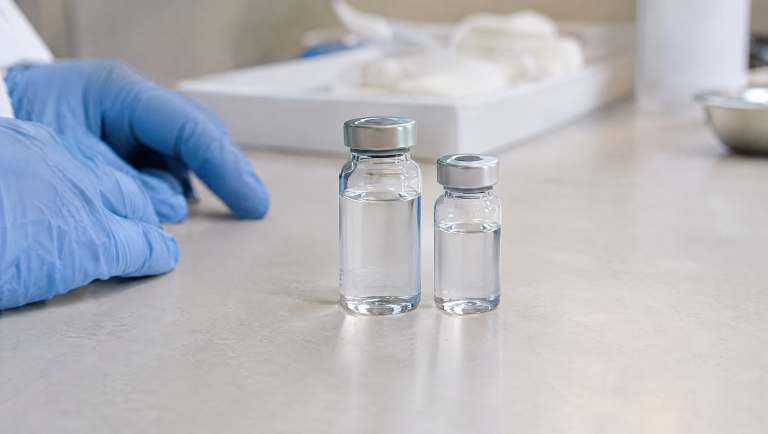

A GLP-1 microdose and a full dose differ in the amount of drug and in the evidence behind it. A full dose follows an FDA-approved schedule tested in large trials, such as 2.4 mg of Wegovy a week. A microdose stays below that schedule. It is not an FDA-approved dosing schedule, and research on it is limited.
The labels are specific about this. Wegovy starts at 0.25 mg a week and climbs every 4 weeks, reaching 1.7 mg in weeks 13 through 16, with 1.7 mg or 2.4 mg as the weight-reduction maintenance dose. Zepbound starts at 2.5 mg, and its label says that dose is for starting treatment and is not approved for maintenance. Its maintenance doses are 5 mg, 10 mg or 15 mg.
Microdosing has no matching document. A 2026 commentary in Expert Opinion on Pharmacotherapy describes it loosely as a fraction of the manufacturer’s starting dose or longer gaps between doses. A Cedars-Sinai article makes the same point more bluntly, saying there is no standard dose and no agreed protocol. Two programs can use the same word and mean different things. Ask what a given plan means by it.
How does the evidence compare for a GLP-1 microdose vs. full dose?
| Full dose on an FDA label | Microdose | |
|---|---|---|
| Schedule | Written in the label. Doses rise in steps of at least 4 weeks. | Set by the prescriber. No standard schedule exists. |
| FDA status | Approved for the labeled brand products. Compounded products are not included. | Not an FDA-approved dosing schedule. |
| Evidence | Large trials. These include STEP 1 and SURMOUNT-1. | Limited. High-quality studies are largely missing. |
| Nausea data | Wegovy 2.4 mg, 44%. Placebo, 16%. | We found no reliable published rate. |
The trial numbers are large, and they get borrowed too freely. In STEP 1, semaglutide 2.4 mg produced a mean weight loss of 14.9% at 68 weeks, against 2.4% on placebo. In SURMOUNT-1, tirzepatide produced 15.0% at 5 mg and 20.9% at 15 mg at 72 weeks, against 3.1% on placebo. Those results belong to the drugs and doses studied. They do not describe a microdose, and they do not describe a compounded product. Compounded drugs are not FDA-approved, and the FDA does not check their safety, effectiveness or quality before they are sold.
Side effects are the reason many people ask about this at all. In SURMOUNT-1, stomach and bowel problems were the most common complaints and mostly came during dose increases. A lower dose sounds like an obvious fix. The 2026 commentary says early reports suggest less nausea, but it also says high-quality evidence remains limited, so that hope is still untested. Dropouts in SURMOUNT-1 for adverse events ran 4.3% at 5 mg, 7.1% at 10 mg and 6.2% at 15 mg, against 2.6% on placebo.
What differs in practice at Living+?
Living+ offers both kinds of plan, and a licensed provider decides whether either one is appropriate, or neither. The weight-loss plans are compounded semaglutide at $197 a month and compounded tirzepatide at $247 a month, each injected weekly. Those plans include labs, unlimited provider visits at no extra cost, two 1-on-1 coaching sessions a month and a 24/7 care team.
The microdose plans are semaglutide at $127 a month and tirzepatide at $149 a month, also injected weekly. They include labs and the 24/7 care team. Certified medical assistants and registered nurses staff that team, which is different from round-the-clock access to a prescriber.
Compounded products are prescribed only when the provider determines an FDA-approved product is not clinically suitable and documents why. That decision belongs to the provider, and a person’s preference for a lower price or a lower dose does not settle it.
The difference people most want to know about is the one nobody can state yet: how much benefit, if any, survives at doses far below the ones that were tested. Full doses have large trials to argue over, and microdoses have very little yet.
Prices were accurate at the time this was published.
Quick answers
Does a GLP-1 microdose work as well as a full dose?
That has not been shown. Large trials tested labeled doses of FDA-approved drugs, and research on microdosing is limited. Microdosing is not an FDA-approved dosing schedule.
Are side effects milder on a microdose?
They might be, but good evidence is missing. Stomach and bowel side effects in full-dose trials were tied to dose increases, and early microdose reports mention less nausea. Those reports are not the same as controlled trial data.
Can I pick between a microdose and a full dose?
No. A licensed provider reviews your health history and decides which plan, if any, is appropriate. The provider may decide not to prescribe at all, and you are not charged if that happens.
How much does each plan cost at Living+?
Microdose plans are $127 a month for semaglutide and $149 a month for tirzepatide. Weight-loss plans are $197 a month for compounded semaglutide and $247 a month for compounded tirzepatide. Compounded drugs are not FDA-approved.
Sources
- DailyMed: Wegovy prescribing information
- DailyMed: Zepbound prescribing information
- Wilding et al., Once-weekly semaglutide in adults with overweight or obesity, NEJM 2021
- Jastreboff et al., Tirzepatide once weekly for the treatment of obesity, NEJM 2022
- Beck and Clements, Considerations and challenges in microdosing of GLP-1-based receptor agonists, Expert Opin Pharmacother 2026
- Cedars-Sinai: Can microdosing GLP-1s promote health and weight loss?
- FDA: Compounding and the FDA, questions and answers
See what a Living+ plan costs and whether it fits.
Wegovy is a registered trademark of Novo Nordisk A/S. Zepbound is a registered trademark of Eli Lilly and Company. Living+ is not affiliated with or endorsed by these companies.