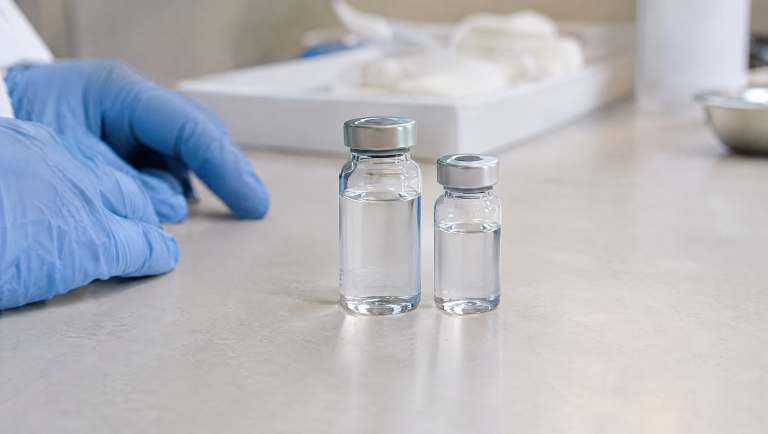

GLP-1 microdosing at Living+ costs $127 a month for semaglutide and $149 a month for tirzepatide, with labs and a 24/7 care team included. Other online programs set their own prices. Microdosing is not an FDA-approved dosing schedule, research on it is limited, and a licensed provider decides whether to prescribe it.
A common assumption is that a smaller dose must come with a smaller bill. The brand price lists do not work that way. NovoCare shows Wegovy pens at $349 a month for every dose from 0.25 mg through 2.4 mg, after a $199 new-patient price on the first two fills of the two lowest doses. Lilly’s self-pay list for Zepbound does step with dose, at $299 for 2.5 mg, $399 for 5 mg and $449 for higher doses when refilled within 45 days. Without that refill timing, the regular price for those higher doses runs $499 to $699. Both offers carry a December 31, 2026 date, and Novo Nordisk says it may change its program at any time.
AARP puts out-of-pocket costs for injectable GLP-1s as high as roughly $1,300 a month, which helps explain why people go looking for something smaller.
Is compounded microdosing the same purchase as a brand drug?
No. The price gap between a compounded product and a brand drug is not a like-for-like comparison. Wegovy and Zepbound are FDA-approved. Compounded drugs are not, and the FDA does not verify their safety, effectiveness or quality before they reach the market. AARP notes that microdoses usually fall below the lowest approved dose, so they are typically compounded.
Some medications prescribed through Living+ are compounded. They are prescribed only when the provider determines an FDA-approved product is not clinically suitable and documents why. A provider can also decide on no prescription, in which case Living+ refunds the full amount.
Low prices deserve a second look in this market. The FDA lists deep discounts among the warning signs for telehealth sellers of GLP-1 drugs, along with no screening by a licensed doctor and incorrect pharmacy addresses. That warning does not mean every lower price is a bad sign, but it does mean the number by itself tells you very little. A seller should be able to explain who evaluates you and which pharmacy fills the prescription, whatever it charges.
What should a GLP-1 microdosing cost include?
Read the checkout page more closely than the ad. The medication is one line, and labs may or may not be another. So may provider visits, needles and syringes, shipping and coaching. Ask whether the monthly figure changes when a provider changes the dose, since that is when a good-looking starting price can drift upward.
The cancellation terms count too. So does the question of what you pay if a provider says no. An online seller that charges first and evaluates later has moved the risk onto you, and it should say so before you hand over a card number.
Here is how the Living+ terms read. Plans are billed monthly, you can cancel anytime, and the exact price is shown before payment. If a provider decides not to prescribe, the refund is full.
What does a year of microdosing cost?
The monthly figure hides the bigger question, which is how long a person would stay on it. At Living+ prices, twelve months comes to $1,524 for semaglutide and $1,788 for tirzepatide. AARP also reports a Cleveland Clinic study in which nearly half of people who stopped their GLP-1 cited money as a reason.
Stopping has its own price. In the extension of the STEP 1 trial, people who came off semaglutide 2.4 mg regained about two-thirds of the weight they had lost within a year. That was a full-dose trial of an FDA-approved drug, so it cannot say what happens after a microdose. We found no study that has measured it, which leaves the honest budget for microdosing open-ended.
Prices were accurate at the time this was published.
Quick answers
What is the cheapest way to microdose a GLP-1?
There is no single answer, and the cheapest offer is not automatically a sound one. The FDA lists deep discounts among warning signs for telehealth sellers. Compare what each monthly price includes, and remember that microdosing is not an FDA-approved dosing schedule.
Does insurance cover GLP-1 microdosing?
AARP reports that coverage for injectable GLP-1 drugs is limited, so many people pay out of pocket. Your plan is the only reliable source for your own coverage. Ask it directly before you count on any benefit.
Is a microdose cheaper than a full dose at Living+?
Yes, the monthly plan price is lower. Microdose plans are $127 for semaglutide and $149 for tirzepatide, and the weight-loss plans are $197 for compounded semaglutide and $247 for compounded tirzepatide. What is included differs between the plans, and a licensed provider decides which is appropriate, if any.
What happens to my money if a provider says no?
At Living+, you are not charged if a provider decides not to prescribe. The exact price is shown before you pay, and you can cancel anytime. Plans are billed monthly.
Sources
- NovoCare: Wegovy self-pay pricing
- Lilly: Zepbound coverage and savings
- AARP: Microdosing GLP-1 drugs for weight loss
- FDA: Compounding and the FDA, questions and answers
- FDA: FDA's concerns with unapproved GLP-1 drugs used for weight loss
- Wilding et al., Weight regain after withdrawal of semaglutide, STEP 1 extension, Diabetes Obes Metab 2022
See what a Living+ plan costs and whether it fits.
Wegovy is a registered trademark of Novo Nordisk A/S. Zepbound is a registered trademark of Eli Lilly and Company. Living+ is not affiliated with or endorsed by these companies.